The Best AI Running Coach for WHOOP Users in 2026
WHOOP is excellent at measuring strain and recovery. It is not a running watch, and it should not quietly become the entire training plan.
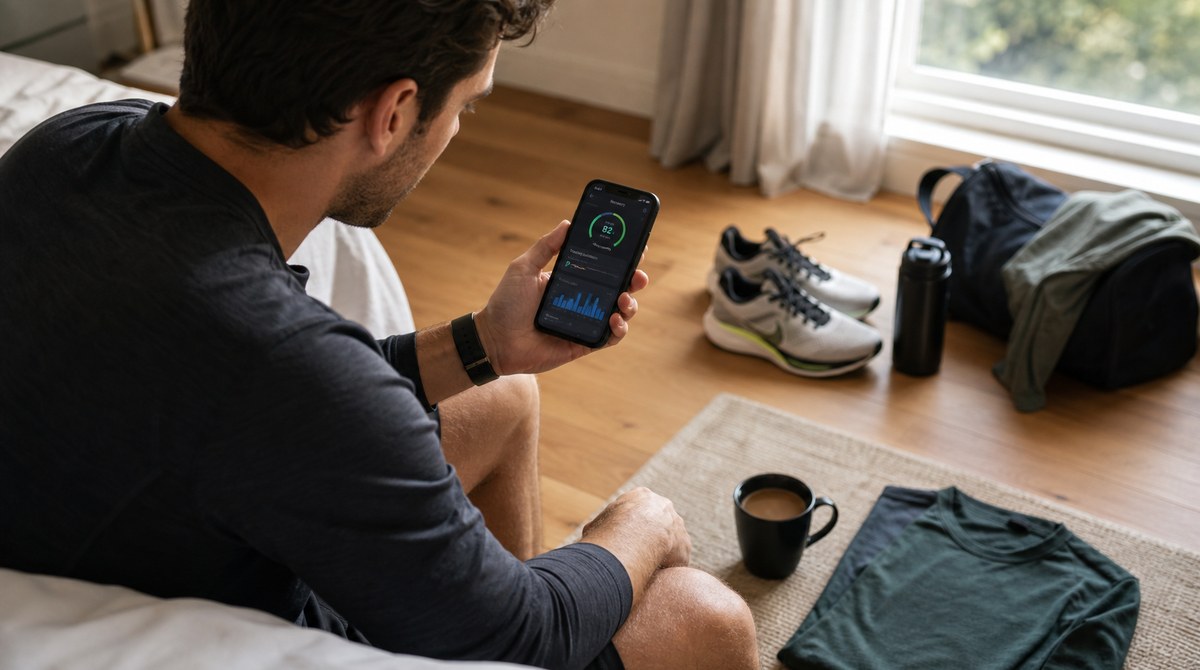
WHOOP earns its place by measuring the things runners are worst at respecting: sleep, resting heart rate, heart rate variability trends, and accumulated strain. It runs quietly in the background and turns recovery into a number that is hard to argue with at 6 a.m.
That is genuinely useful. It is also easy to misuse. A recovery score can pull a runner away from a key workout after one bad night, or give false confidence on a day that looks green but follows three weeks of creeping fatigue. WHOOP is strong context. It is not a coach, and it is not a GPS running watch.
Disclosure: The Running Genie is the app behind this site. This article is written to explain the WHOOP-plus-coaching decision honestly, not to claim that a recovery band replaces a training plan or a running watch.
1. What WHOOP does well for runners
WHOOP is built around continuous physiology rather than the workout itself. Its strengths are overnight and across weeks: sleep quality and duration, resting heart rate, HRV trends, and a daily recovery read that combines them. For runners, that fills a real blind spot, because most running apps see the run and ignore everything that happens in the other twenty three hours.
Strain is the other half. WHOOP tracks cardiovascular load across the whole day, which can be a useful sanity check when easy runs are not actually easy or when life stress is quietly adding to training stress.
2. What WHOOP is not built to do
WHOOP is not a primary GPS device. It is not the tool for accurate distance, pace, splits, route, or elevation, and it does not run structured workouts the way a dedicated running watch does. A coach that only saw WHOOP data would know how hard a runner was working and how recovered they were, but not what the actual session was.
That is the gap. Recovery without running data is half the picture, and running data without recovery context is the other half. Good coaching needs both.
3. The right WHOOP running setup
The most reliable setup for WHOOP runners is layered:
- WHOOP for sleep, strain, and recovery trends.
- A GPS workout source for runs: a running watch, Apple Watch, or a phone-based source through Garmin, Strava, Apple Health, or Health Connect.
- A coaching app to turn all of that into a decision about the next session.
Skip the GPS source and the coach has no training to work with. Skip the recovery source and the coach may miss why a good plan is not landing. Skip the coaching layer and there are dashboards, but no plan.
4. How recovery should change training, not run it
The honest way to use WHOOP is as an adjustment, not a command. A poor recovery read after a hard week is a reason to soften an easy day or move a workout, not a reason to abandon a season of structure. A strong read is permission to execute the planned session well, not an invitation to add unplanned intensity.
This matters because recovery numbers are noisy. Heat, alcohol, a late meal, travel, and a restless night can all dent a score without meaning fitness has dropped. A plan that reacts to every daily wobble becomes incoherent. A plan that ignores recovery entirely becomes risky. The useful middle is a plan that holds its shape but flexes at the edges.
5. Where The Running Genie fits
The Running Genie is built for the decision layer. It turns recent runs and training history into adaptive paces and plan updates, and it is designed to treat recovery as context that keeps the plan conservative rather than as a separate scoreboard to chase.
The honest promise is not that WHOOP becomes the coach. It is that running data drives the plan, and recovery context helps the plan avoid stacking hard days on top of a tired runner. WHOOP supplies the recovery side of that conversation well, and a GPS source supplies the runs. For the recovery fundamentals behind all of this, the running recovery guide and the explainer on elevated running heart rate are good companions.
6. How to choose
If you use WHOOP plus a GPS watch and want adaptive paces: a coaching app like The Running Genie is a strong fit, with recovery used as context rather than command.
If you want a polished, prescriptive race plan: a mainstream plan app is the easiest on-ramp, with WHOOP used personally on the side.
If you want heavy physiology and training-stress language: a more technical endurance platform may suit better.
If WHOOP is your only data source: add a running source first. Recovery alone cannot coach a runner who has no run data.
The Running Genie turns recent running data into adaptive training paces and plan updates, with recovery used as context. Free to download, with Strava, Garmin, Polar, Suunto, Apple Health, Health Connect, and file-upload paths depending on platform and device.
Use WHOOP for recovery. Use a watch for running. Use a coach for the decision that connects them.
Recovery should shape the plan, not become it.