WHOOP vs Oura for Runners: Which Recovery Tracker Actually Helps Training?
Both devices measure recovery well. The real question for runners is which one fits their habits, and how recovery data should change training in the first place.
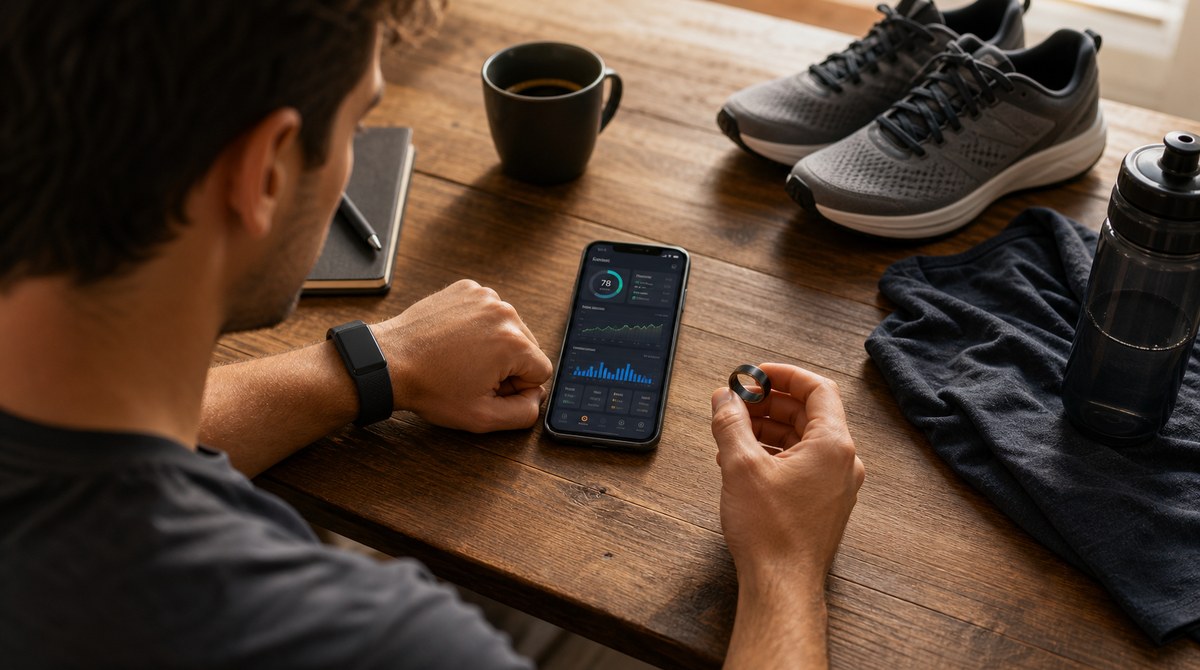
WHOOP and Oura are the two recovery trackers most runners end up comparing. They overlap heavily: both watch sleep, resting heart rate, heart rate variability, and a daily readiness or recovery read. Neither is a GPS running device, and neither should be mistaken for a training plan. The differences that matter are about form, focus, and habit.
Disclosure: The Running Genie is the app behind this site. This comparison is written to help runners choose a recovery tool honestly, not to claim that any recovery tracker can coach a runner on its own.
1. What they share
At their core, WHOOP and Oura answer the same question: how recovered is the body today, and how has it been trending? Both build a personal baseline from overnight physiology and translate it into a score. Both are at their best when a runner uses that score to decide whether to push or ease, rather than to chase a higher number.
2. Where WHOOP leans
WHOOP is built around continuous strain and a coaching-style recovery read. It tracks cardiovascular load across the whole day, which appeals to runners who want a single system that frames training and recovery together. The wrist or apparel-based strap is designed to be worn constantly, and the experience pushes the runner toward a daily decision: given this recovery, how hard should today be?
The trade-offs are a subscription model and a band that some runners would rather not wear during the day. For runners who like an always-on load-and-recovery dashboard, that is a fair exchange.
3. Where Oura leans
Oura puts sleep and a discreet ring form factor first. Many runners find a ring easier to live with than a wrist device, especially overnight, and Oura's sleep and readiness reporting is its strongest suit. It is less focused on continuous daytime strain and more on the overnight recovery story.
For runners whose main blind spot is sleep, and who want recovery insight without another wrist device, Oura is an easy fit. The deeper look at pairing it with running lives in the Oura running coach guide.
4. The thing both get wrong on their own
Used in isolation, both devices invite the same mistake: treating a recovery score as a verdict. A single low reading is noisy, and a single high reading is not a license to add unplanned intensity. Recovery data earns its value as a trend that moderates a plan, not as a daily scoreboard. The fundamentals of what actually restores a runner are in running recovery: what works.
5. Neither replaces a running watch
This is the part runners most often skip. WHOOP and Oura do not capture accurate distance, pace, splits, or route. A coach built on top of either one would know how recovered a runner is but not what they actually ran. The reliable structure is the same in both cases:
- A recovery tracker (WHOOP or Oura) for sleep, HRV, and readiness.
- A GPS workout source for the runs: a running watch, Apple Watch, or a phone-based source through Strava, Apple Health, or Health Connect.
- A coaching app to turn runs and recovery context into the next decision.
6. How to choose
Choose WHOOP if: you want continuous strain plus recovery in one always-on system and do not mind a band and subscription.
Choose Oura if: sleep is your weak point and you prefer a discreet ring you barely notice overnight.
Either way: add a GPS running source, and use the recovery score to adjust a real plan rather than to run training by itself.
7. Where The Running Genie fits
Whichever tracker a runner picks, the missing piece is usually the decision layer. The Running Genie turns recent runs into adaptive paces and progression, and it is designed to use recovery as context that keeps the plan conservative rather than as a number to optimise. The recovery device handles readiness, the GPS source handles the runs, and the coaching layer connects them into a plan that holds its shape across a season.
The Running Genie builds adaptive plans from your real running data and stays conservative when recovery context suggests easing off. Free to download, with Strava, Garmin, Polar, Suunto, Apple Health, Health Connect, and file-upload paths depending on platform and device.
WHOOP or Oura is the wrong first question. The first question is how recovery should change a plan that already exists.
Pick the tracker you will actually wear. Then let it adjust real training.