How long does it take to train for a 5K?
Shorter than most people expect. The honest answer depends on your starting point:
- True beginner (little or no running): 6–10 weeks. You start with walk-run intervals — run 1 minute, walk 2, repeat — and gradually shift the ratio toward running. Walk-run is not cheating; it's how almost everyone builds to continuous running safely.
- Already active (gym, cycling, occasional runs): 4–6 weeks. Your heart and lungs are ahead of your legs, so the plan's job is mostly getting tendons and muscles used to running impact without overdoing it.
- Regular runner chasing a faster time: a focused 6–8 week block with structured intervals and tempo work will move your 5K time more than months of the same casual runs.
In every case, three runs a week is enough: one easy run, one session with faster bursts (intervals or fartlek), and one slightly longer easy run. More than that helps experienced runners, but for a first 5K it mostly adds injury risk.
What a good 5K training week looks like
A typical mid-plan week on 3 running days:
- Tuesday — easy run (3–4 km at a conversational pace; for beginners this can be walk-run intervals)
- Thursday — fartlek or intervals (e.g. 10 minutes easy, then 6 × 1 minute faster with 90-second recovery jogs, 10 minutes easy)
- Saturday or Sunday — longer easy run (4–6 km, the slowest and most relaxed run of the week)
The pattern that matters: most running easy, a small dose of faster work, and one run that gradually gets longer. The easy runs build the aerobic engine; the faster bursts teach your legs to turn over; the longer run makes 5 km feel normal instead of intimidating.
From 5K to 10K
A lot of runners search for a "5K to 10K training plan app" within weeks of their first finish line — the 5K hooks you, and 10K is the natural next step. The good news: the step up is mostly patience, not new methods.
The core move is growing the weekly long run by roughly 1 km per week — from 5 km toward 8–9 km over six to eight weeks — while keeping around 80% of all running at an easy pace. A fourth easy run can join the week once three feel comfortable. Everything else stays familiar: one faster session, easy days between hard days, and a lighter week every third or fourth week to absorb the buildup. Most runners are 10K-ready 6–10 weeks after a solid 5K.
Why a fixed 5K plan breaks
Printable couch-to-5K schedules and PDF plans share one flaw: they assume nothing goes wrong. Then week 3 arrives with a cold, a work deadline, or legs that just aren't ready for week 4's jump. A fixed plan gives you two bad options — cram the missed sessions (hello, shin splints) or fall behind and quietly give up. The other failure mode is the opposite: the plan is too easy, you plateau, and boredom wins.
An adaptive plan fixes both. When a week goes sideways, the schedule rebuilds around what actually happened instead of pretending it didn't. When sessions feel too easy, the targets tighten. The plan meets you where you are, every week — which is what a human coach would do.
How to get your 5K plan in The Running Genie
Download the app and connect your runs
Sign in with Strava, Garmin, Polar, Suunto, or Apple Health. Any running (or walking) history syncs automatically, so the AI measures your real starting fitness instead of asking you to guess it.
Set a 5K goal
Pick a 5K race from the calendar and add its date — or choose "build fitness" if you just want to reach the distance without a race deadline. A target time is optional.
Answer a few profile questions
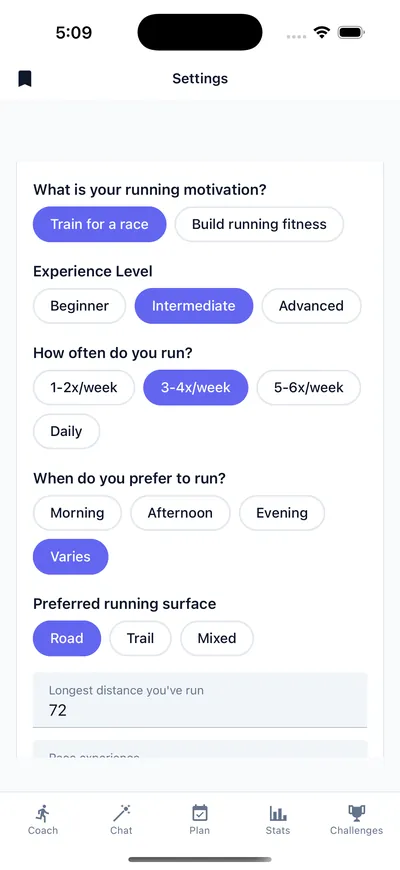
Experience level (beginner or intermediate), how many days a week you can run, and what motivates you. Beginners get walk-run friendly sessions from day one.
Get your generated plan
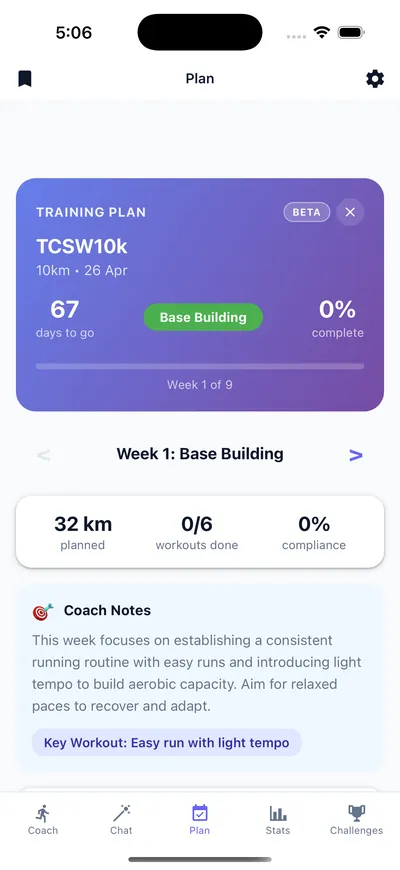
In about two minutes you have a week-by-week 5K plan: easy runs, faster sessions, and a longer run that grows steadily — with paces calculated from your own data using the Daniels VDOT model.
Check in, and let the plan adapt
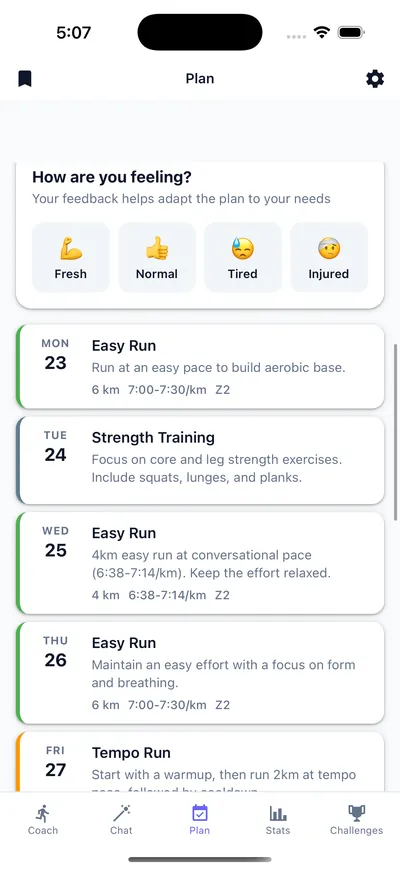
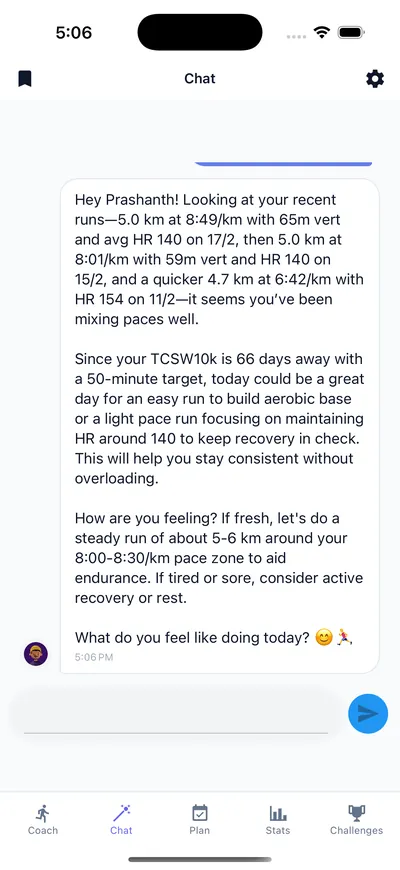
Each week you tell the app how you're feeling — fresh, normal, tired, or injured — and it looks at what you actually ran. The next week adjusts accordingly, and the AI coach explains every change in plain language.
What that looks like in the app
Free and Pro, honestly
The Running Genie is free to download on iOS and Android. The free tier includes AI coach conversations, run syncing, and a free preview of your personalized plan. Full plan access — the complete week-by-week schedule with ongoing adaptation — is part of the Pro subscription ($7.99/month or $49.99/year). What's free and what's Pro is clear before you start, and no plan is paywalled mid-training.
5K training FAQ
How long does it take to train for a 5K?
A true beginner needs 6 to 10 weeks, starting with walk-run intervals and building to continuous running. If you're already active — cycling, gym sessions, occasional runs — 4 to 6 weeks is usually enough. Three runs a week is plenty: one easy run, one session with faster bursts, and one slightly longer easy run.
Is there a free 5K training plan app?
The Running Genie is free to download on iOS and Android. The free tier includes AI coach conversations, run syncing, and a free preview of your personalized 5K plan. The full week-by-week plan with ongoing adaptation is part of the Pro subscription. The website's running calculators — race time predictor, VDOT calculator, pace tools — are completely free with no account needed.
Can I go from couch to 5K with The Running Genie?
Yes. Set your experience to beginner and the plan starts where you are — walk-run intervals are a legitimate part of early sessions. Unlike a rigid Couch to 5K script that marches through the same nine weeks for everyone, the plan adapts: repeat a week that felt hard, progress faster if sessions feel easy, and the schedule reshapes around missed days instead of falling apart.
What is a good 5K time?
For a first 5K, anywhere from 30 to 40 minutes is a solid result — finishing is the goal. Regular runners typically land between 22 and 30 minutes. Breaking 20 minutes puts you at a competitive club level. Age and experience matter more than any single benchmark, so compare against your own previous times rather than someone else's.
How do I get faster at 5K?
Three levers: intervals (short repeats faster than 5K pace with recovery jogs), tempo runs (sustained efforts near race pace), and more easy volume to grow your aerobic base. Most runners underdo the easy running and overdo the hard days. The Running Genie calculates your personal interval, tempo, and easy paces from your actual running data using the Daniels VDOT model, so every session has a precise target.
Start your 5K plan today
Download The Running Genie free, connect your runs, and preview a 5K plan built around your starting fitness and your schedule — in about two minutes.


Free download · Works with Strava, Garmin, Polar, Suunto & Apple Health