Why people look for a Couch to 5K alternative
The short answer: C25K is one fixed script for every body, and bodies differ. The program's simplicity is its greatest strength — and the source of every complaint about it. The friction points people actually hit:
- The pace of progression doesn't fit everyone. Week 5's jump to longer continuous running feels brutal for some runners, while others — especially those with a fitness base from cycling or gym work — find the early weeks so easy they get bored and drift away.
- There's no adjustment when life happens. Miss a week with a cold or a work trip and the standard advice is to repeat the last week you completed — or drop back further. The script can't reshape around what actually happened.
- There's no pace guidance. C25K tells you when to run and when to walk, but never how fast. Many people run their intervals too hard, which is a big reason the middle weeks feel impossible.
- It stops at week 9. You can run for 30 minutes — then what? There's no built-in path to a faster 5K, a 10K, or a half marathon. Plenty of graduates simply stop, not because they wanted to, but because the road ended.
None of that makes C25K bad. It makes it a specific tool: excellent for absolute beginners who want a dead-simple, proven on-ramp, and a poorer fit once you need the plan to bend around you.
What to look for in your next running app
If the fixed script didn't fit, these are the criteria that matter in whatever replaces it:
- It starts from your actual level — not week 1 by default. If you can already run 10 minutes at a stretch, the plan should begin there.
- It keeps walk-run as a legitimate tool. Walk breaks aren't training wheels to be ashamed of; they're how many experienced runners handle long runs. A good plan uses them deliberately rather than treating continuous running as the only goal.
- It adapts when life happens. A missed week, an illness, or a stretch of heavy legs should reshape the coming weeks — not send you back to a checkpoint.
- It gives pace targets as you progress. Knowing how easy your easy runs should be prevents the too-hard-too-soon spiral that kills most beginner attempts.
- It has a road beyond 5K. The plan that gets you to 30 minutes should be able to take you toward a faster 5K, a 10K, or eventually a half marathon without switching apps.
Life after Couch to 5K
If you're here because you finished C25K, congratulations — that's the hard part. The graduate path has two stages:
First, consolidate. Run your 5K (or 30 minutes) comfortably about three times a week for three to four weeks. Don't chase distance or speed yet. The goal is for 5K to feel normal rather than a peak effort — that's the base every next step builds on.
Then pick a direction. Either get faster over 5K — adding one weekly quality session of intervals or a tempo run while the other runs stay easy — or go longer, extending one run per week gradually toward 10K. A well-built plan periodizes either path the same way: most running stays easy, volume climbs in small steps, and every third or fourth week eases off so your body absorbs the work. That's the structure C25K gave you for weeks 1–9, extended indefinitely.
How The Running Genie picks up where C25K stops (or replaces it)
The Running Genie is an AI running coach that builds the plan around you instead of handing you a script. If you're starting out, the beginner setting builds a gentle, walk-run-friendly start from your current fitness — not from week 1 by default. If you're a C25K graduate, it takes your actual runs and builds a plan toward whatever comes next: a faster 5K, a first 10K, or eventually a half marathon.
Every workout comes with a plain-language explanation from the AI coach — what the session is for and how it should feel — and the plan adapts weekly to your feeling check-ins (fresh, normal, tired, or injured) and to what you actually ran. A hard week eases the next one; a missed week reshapes the buildup instead of resetting it.
How to get started
Download the app free
The Running Genie is free to download on iOS and Android — no card required to start.
Connect your runs
Sign in with Strava, Garmin, Polar, Suunto, or Apple Health. Phone-only runners are covered too: track runs with your phone's health app or Strava's free app, and they sync automatically.
Answer the profile questions honestly
Your experience level, how many days a week you can realistically run, and any goal race. Honest answers here are what make the plan start from where you actually are.
Preview your plan
See the weekly structure the AI builds for you — including walk-run sessions if that's where your fitness is — before committing to anything.
Run, and let it adapt
Each week the plan adjusts to what you ran and how you said you were feeling. No repeating weeks, no starting over — the plan meets you where you are.
What that looks like in the app
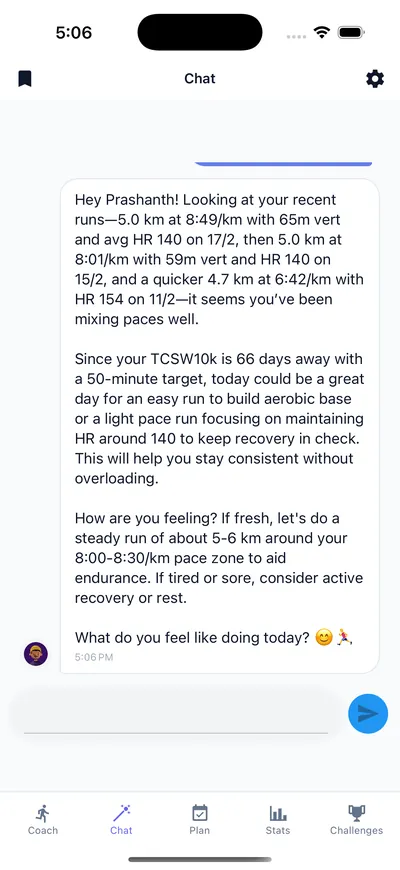
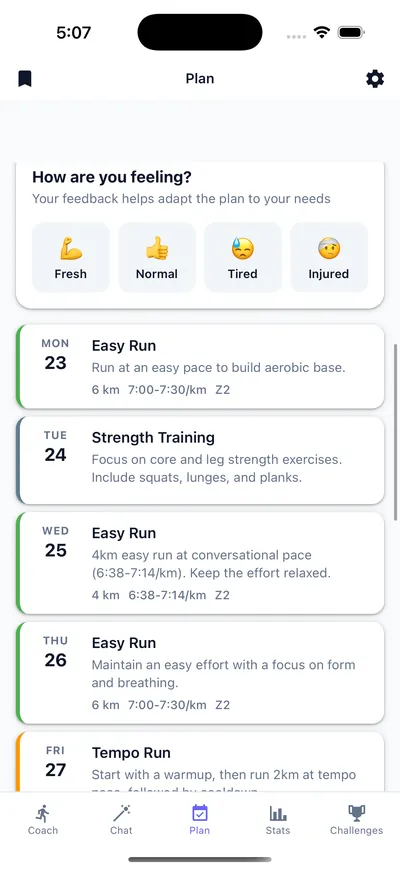
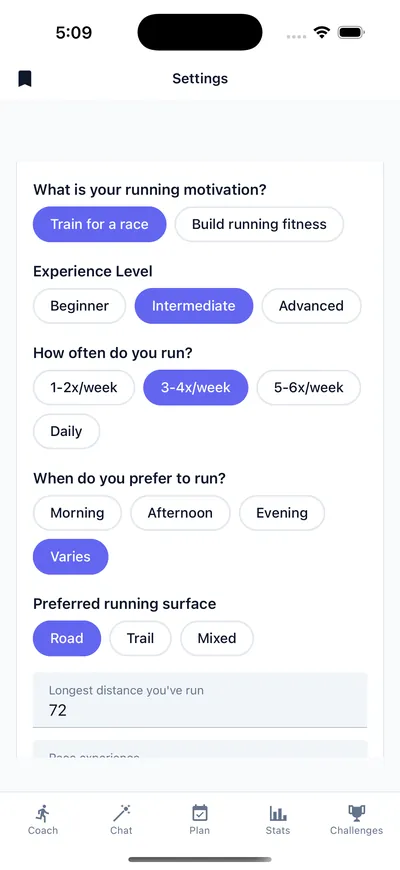
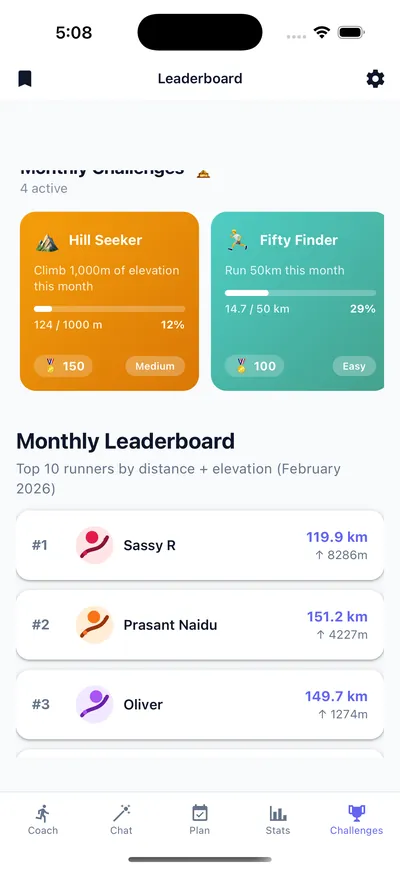
Free and Pro, honestly
The Running Genie is free to download on iOS and Android. The free tier includes AI coach conversations, run syncing, and a preview of your personalized plan. Full adaptive plans — the complete week-by-week schedule with ongoing adaptation — are part of the Pro subscription ($7.99/month or $49.99/year). What's free and what's Pro is clear before you start.
Couch to 5K alternative FAQ
What is a good alternative to Couch to 5K?
A good alternative starts from your actual fitness instead of week 1 by default, keeps walk-run intervals as a legitimate tool, adapts when you miss sessions or find a week too hard, and offers a path beyond 5K. An adaptive coaching app like The Running Genie fits those criteria; if you have never run at all and just want the classic fixed program, Couch to 5K itself remains a fine choice.
What should I do after finishing Couch to 5K?
First consolidate: run 5K comfortably about three times a week for a few weeks so the distance feels normal rather than a peak effort. Then pick a direction — get faster over 5K with intervals and tempo runs, or go longer with a 5K-to-10K progression. A structured plan should periodize either path with gradual volume increases and regular easier weeks.
Is it OK to walk during runs after Couch to 5K?
Yes. Walk-run is a legitimate training tool at every level, not something to graduate out of. Planned walk breaks let you cover more distance with less strain, and many experienced runners use them in long runs and even races. What matters is total time on your feet and consistency, not whether every step was run.
Do I have to start over if I miss a week?
With a fixed script, often yes — the usual advice is to repeat the last completed week, and after a longer break to drop back further. An adaptive plan reshapes instead: it looks at what you actually ran and rebuilds the coming weeks from there, so a missed week costs you a little progress rather than sending you back to a checkpoint.
Is The Running Genie free?
The app is free to download on iOS and Android. AI coach conversations, run syncing, and a preview of your personalized plan are included in the free tier. Full adaptive plans — the complete week-by-week schedule that adjusts as you go — are part of the Pro subscription at $7.99/month or $49.99/year.
Try a plan that starts from where you are
Download The Running Genie free, answer a few honest questions about your running, and preview a plan built around your fitness — walk-run friendly if that's your level, and with a road that keeps going after 5K.


Free download · Works with Strava, Garmin, Polar, Suunto & Apple Health