How long do you need to train for a half marathon?
For most runners, 8 to 14 weeks. The honest answer depends on where you're starting from:
- You can run 5K comfortably: plan for 12 weeks. This gives the long run time to build gradually without big weekly jumps.
- You already run 25+ km per week: 8–10 weeks is enough, and training shifts toward pace — tempo runs and race-pace segments rather than just covering the distance.
- You're starting from very little running: give it 16–20 weeks, or run a 5K and 10K first. Rushing the buildup is the most common cause of injury in first-time half marathoners.
Whatever the timeline, the structure is the same: a weekly long run that grows steadily, one quality session (tempo or intervals), easy runs in between, a cutback week every third or fourth week, and a 10–14 day taper before race day.
What a week of half marathon training looks like
A typical mid-plan week on 4 running days:
- Tuesday — easy run (5–7 km, conversational pace)
- Thursday — tempo run (e.g. 2 km warm-up, 3–5 km near race pace, cool-down)
- Saturday — easy run or rest
- Sunday — long run (10–18 km depending on the week, easy pace)
Around 80% of weekly running should be at an easy pace — usually 60–90 seconds per km slower than goal race pace. That feels too slow to most people, and it's exactly why the 80/20 method works: easy running builds the aerobic engine that carries you through the last 5 km, while the small hard fraction sharpens speed.
Not sure what your race pace should be? The free race time predictor estimates your half marathon time from a recent 5K or 10K.
Why a static plan falls apart by week 5
Downloadable 12-week PDF plans assume nothing goes wrong: no missed week, no cold, no work trip, no heavy legs. In reality almost every training block hits a disruption — and a fixed plan can't respond. Runners either cram the missed sessions (injury risk) or fall behind and lose confidence.
This is the core argument for an adaptive half marathon training app: the plan should be rebuilt around what actually happened, not what was supposed to happen. Miss a week? The buildup reshapes instead of skipping ahead. Crushing your paces? The targets tighten. Feeling run down? The next sessions ease off before a niggle becomes an injury.
How to train for a half marathon with The Running Genie
Download the app and connect your runs
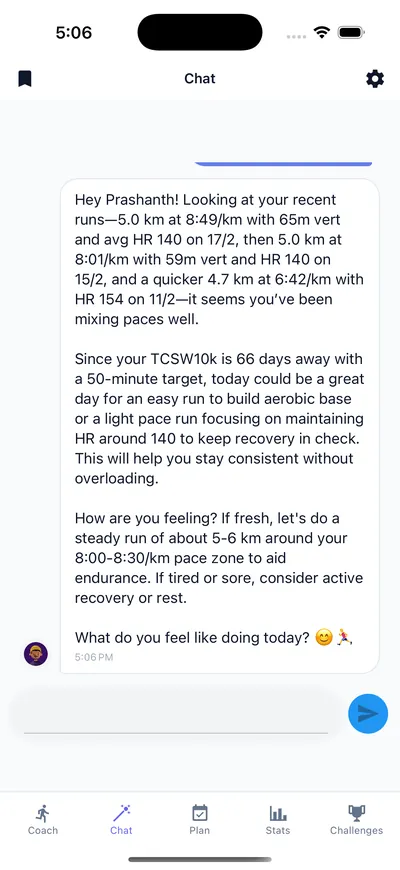
Sign in with Strava, Garmin, Polar, Suunto, or Apple Health. Your running history syncs automatically — the AI uses it to measure your current fitness instead of asking you to guess.
Set your half marathon as the goal race
Add the race name, date, and a target time if you have one. Tune-up races (a 10K a month out, say) can go on the calendar too, and the plan trains through or tapers for them sensibly.
Get your personalized plan
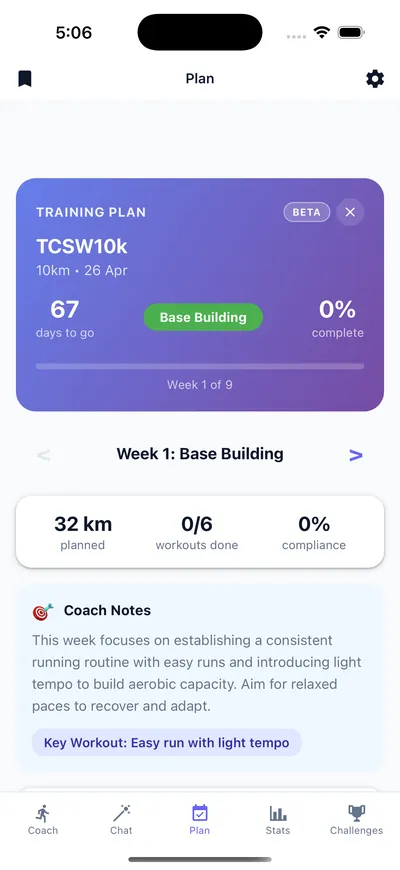
The plan is generated in about two minutes: weekly structure, long run progression, tempo sessions, and paces calculated from your Daniels VDOT score — built backwards from race day so the taper lands exactly right.
Train, and let the plan adapt
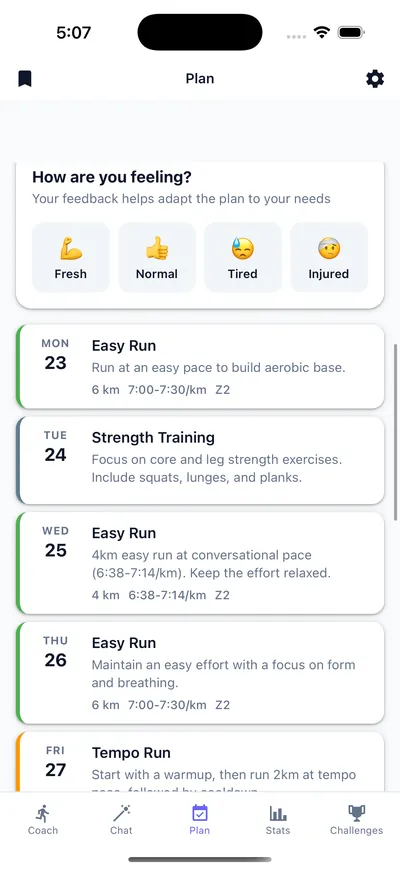
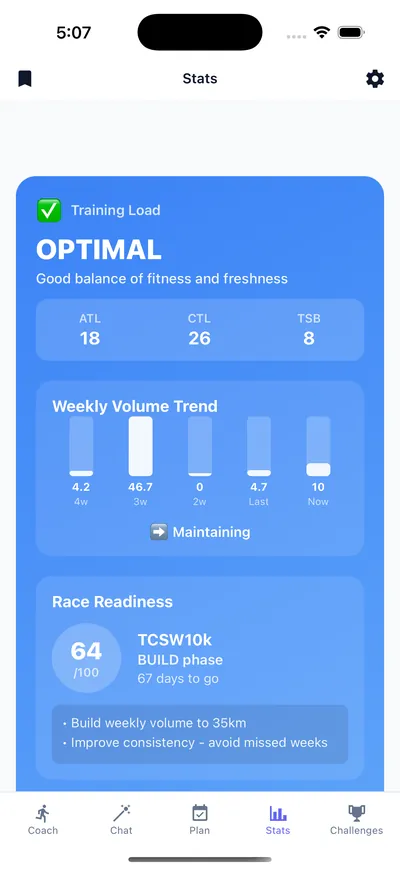
Each week the app looks at what you actually ran and how you say you're feeling — fresh, normal, tired, or injured — and adjusts the next week's volume and intensity. The AI coach explains every change in plain language.
Race with a pacing strategy
Before race day, you get a pacing plan matched to your fitness: where to hold back, when to push, and what splits to aim for.
What that looks like in the app
Free and Pro, honestly
The Running Genie is free to download on iOS and Android. The free tier includes AI coach conversations, run syncing, and a free preview of your personalized plan. Full plan access — the complete week-by-week schedule with ongoing adaptation — is part of the Pro subscription ($7.99/month or $49.99/year). No plan is paywalled mid-training: what's free and what's Pro is clear before you start.
Half marathon training FAQ
How long do you need to train for a half marathon?
Most runners need 8 to 14 weeks. If you can currently run 5K comfortably, 12 weeks is a sensible target. Experienced runners preparing for a faster time can be ready in 8 to 10 weeks. The Running Genie builds the plan backwards from your race date, so the length always fits your calendar and current fitness.
Can a beginner train for a half marathon in 12 weeks?
Yes, if you already run 2-3 times a week and can cover 5K without stopping. A beginner-friendly 12-week half marathon plan builds the long run gradually from around 6-8 km to 18-19 km, keeps most running at an easy pace, and includes cutback weeks for recovery. Starting from zero running experience, a longer runway of 16-20 weeks is safer.
Do I need to run 21 km in training before the race?
No. Most half marathon plans peak the long run at 16-19 km. Race-day adrenaline, taper freshness, and crowd support carry you through the final stretch. Running the full distance in training adds injury risk without much fitness benefit for most runners.
What pace should half marathon training runs be?
Around 80% of training should be at an easy, conversational pace — typically 60-90 seconds per km slower than your goal race pace. Tempo runs sit close to race pace, and intervals go faster. The Running Genie calculates your personal easy, tempo, and race paces from your actual running data using the Daniels VDOT model, so you never have to guess.
Is The Running Genie's half marathon plan free?
The app is free to download on iOS and Android, and you can preview your personalized half marathon plan for free. Full plan access with weekly adaptation is part of the Pro subscription. AI coach conversations and run syncing are included in the free tier.
Start your half marathon plan today
Download The Running Genie free, connect your runs, and preview a half marathon plan built around your race date and current fitness — in about two minutes.


Free download · Works with Strava, Garmin, Polar, Suunto & Apple Health